
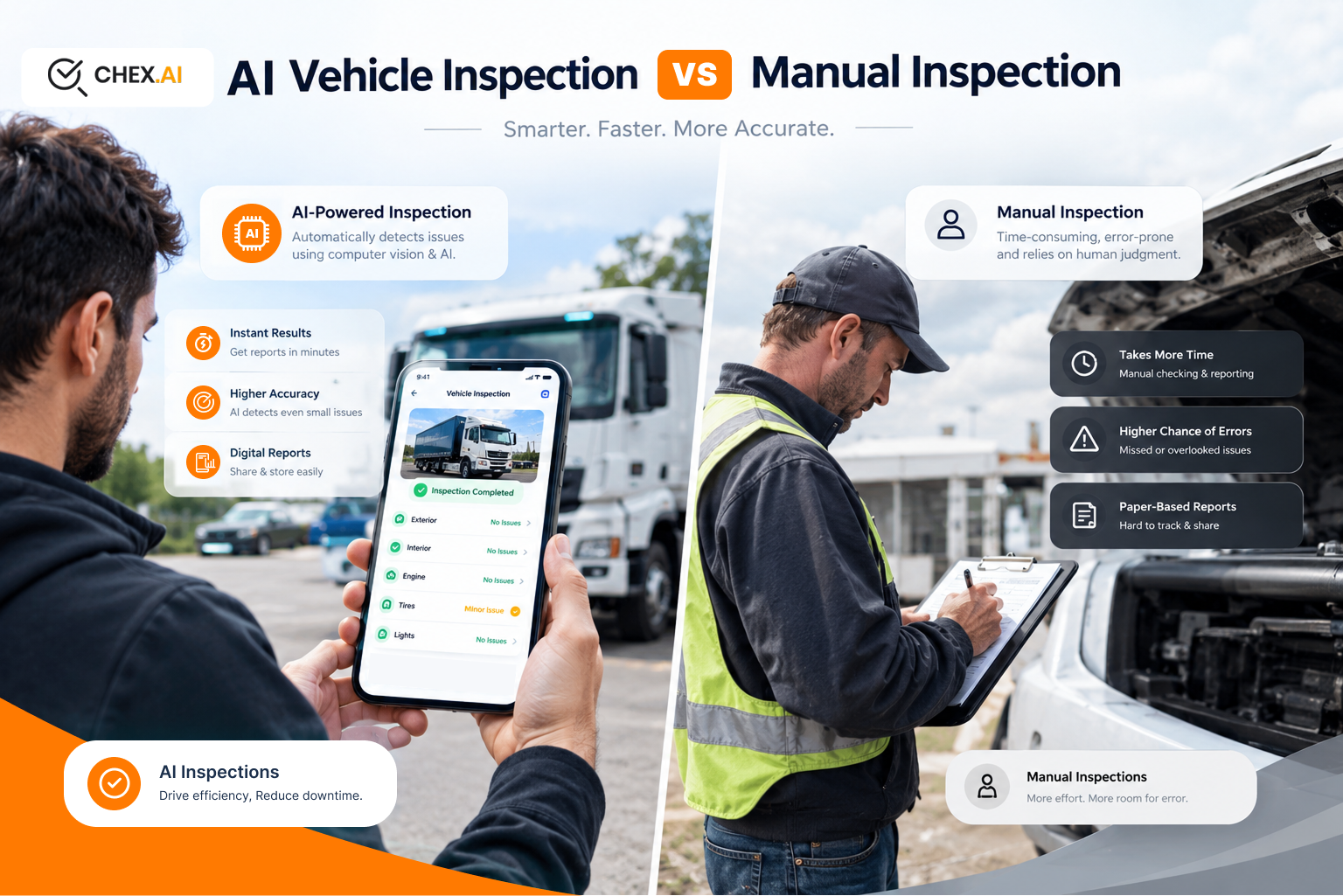
Short answer: An AI vehicle inspection uses a smartphone camera and computer vision to detect and document vehicle damage in minutes, while a manual inspection relies on a person visually checking the car at a shop or lot. AI inspections are faster, more consistent, cheaper at scale, and create a timestamped digital record. Manual inspections still matter for hands-on mechanical checks that a camera can't see. For most rideshare drivers, fleets, insurers, and rental companies, AI inspection is now the better default, with manual checks used only where physical testing is required.
Key Takeaways
- Speed: An AI vehicle inspection takes minutes from a phone. A manual inspection usually means booking a slot, driving to a shop, and waiting.
- Consistency: AI applies the same standard to every vehicle. Manual results vary by inspector, lighting, and time of day.
- Accuracy: Chex.AI detects damage across 163 vehicle parts with 95–99% accuracy and identifies 21 damage types.
- Documentation: AI produces a standardized, timestamped digital report automatically. Manual inspections often end in paper forms or handwritten notes.
- Cost: AI removes travel time, shop fees, and inspector labor, which adds up quickly for fleets and insurers.
- Best fit: Use AI for condition, damage, and compliance documentation. Use a mechanic for tasks that require physically testing parts.
What Is a Manual Vehicle Inspection?
A manual vehicle inspection is a physical walkaround performed by a person, usually a mechanic, lot attendant, field adjuster, or the driver, who checks the vehicle by eye and records the results on a paper or digital form.
Common examples include:
- Rideshare inspections at a certified mechanic, where the driver brings the Uber or Lyft inspection form to be signed off
- Fleet DVIRs (Driver Vehicle Inspection Reports) completed on paper at the end of a shift
- Insurance field inspections where an adjuster visits the vehicle in person
- Rental check-in and check-out walkarounds at the counter
Manual inspection has been the industry standard for decades. Its weakness isn't that people are careless; it's that people are different. Two inspectors looking at the same bumper can reach two different conclusions.
What Is an AI Vehicle Inspection?
An AI vehicle inspection, sometimes called a digital vehicle inspection or virtual vehicle inspection, uses a smartphone app and computer vision to capture, analyze, and document a vehicle's condition.
With Chex.AI, the process works like this:
- Capture: The driver or inspector follows on-screen prompts to take guided 360° photos and video of the vehicle.
- Check quality: The app flags blurry, incomplete, duplicate, or manipulated images and asks for a retake before anything is submitted.
- Detect: AI car damage detection analyzes every angle and identifies dents, scratches, cracks, and other damage across 163 parts.
- Auto-read: The VIN, license plate, and odometer are read automatically, so there's no manual data entry.
- Report: A standardized, timestamped inspection report is generated, ready for approval, claims, compliance, or underwriting.
For a deeper walkthrough, read What Is an AI Vehicle Inspection? How Automated Car Inspections Work.
AI Vehicle Inspection vs Manual Inspection Side-by-Side Comparison
| Factor | Manual Inspection | AI Vehicle Inspection (Chex.AI) |
|---|---|---|
| Time to complete | Often hours, including travel and waiting | Minutes from a smartphone |
| Location | Shop, lot, or on-site adjuster visit | Anywhere with a phone |
| Consistency | Varies by inspector and conditions | Same standard applied to every vehicle |
| Damage detection | Depends on inspector's eye and attention | 163 parts, 21 damage types, 95–99% accuracy |
| Documentation | Paper forms, handwritten notes | Timestamped digital report with photo evidence |
| Fraud protection | Hard to verify photos or forms | Flags manipulated, duplicate, or stale images |
| Data entry | Manual VIN, plate, odometer entry | Auto-scanned VIN, plate, odometer |
| Scalability | Needs more inspectors for more vehicles | Scales instantly across fleets and regions |
| Cost at scale | Labor, travel, downtime, shop fees | Lower per-inspection cost, no travel |
| Dispute resolution | Relies on memory and paperwork | Photographic, timestamped audit trail |
| Mechanical testing | Can physically test parts | Limited to what a camera can capture |
1. Speed
Speed is the most obvious difference.
A manual inspection involves finding a shop, booking an appointment, driving there, waiting in line, and sometimes coming back if the paperwork is wrong. For a rideshare driver, that's time off the road and lost earnings.
With an AI inspection, the driver completes the process from their driveway. Chex.AI rideshare drivers typically finish the Uber or Lyft inspection online in about 30 minutes, with same-day certification.
For fleets, the difference compounds. Cutting even 30 minutes per vehicle across 200 trucks recovers hundreds of hours of uptime every inspection cycle.
2. Accuracy and Consistency
Manual inspections are only as good as the person performing them. Fatigue, poor lighting, rushed shifts, and different experience levels all affect results. A small scratch spotted by one inspector may be missed by another.
AI doesn't get tired and doesn't change its standard. Chex.AI's model is trained to detect 21 types of damage across 163 vehicle parts at 95–99% accuracy, and it applies that same benchmark to the first car of the day and the five-hundredth.
That consistency matters most when inspections are used to make decisions, such as approving a driver, settling a claim, or charging a renter for new damage.
3. Documentation and Compliance
A manual inspection often ends with a signed paper form. Paper gets lost, is hard to search, and is easy to dispute.
AI inspections produce a standardized digital report with timestamped photos for every vehicle. That creates an audit-ready record for:
- Commercial fleets: Federal rules under 49 CFR §396.11 require motor carriers to have drivers report defects affecting safe operation, covering components such as brakes, steering, lights, tires, and mirrors. Digital DVIRs make that record easier to create, store, and produce during an audit. Learn more in our guide: What Is a DVIR?
- Rideshare platforms: Drivers need a valid inspection on file to stay active. Uber and Lyft both publish vehicle requirements that include passing an inspection in many markets.
- Insurance: Underwriting and claims teams get standardized evidence without sending a field adjuster.
4. Cost
Manual inspection costs aren't just the inspection fee. They include:
- Shop or inspector fees
- Driver travel time and fuel
- Vehicle downtime
- Admin time spent filing and chasing paperwork
- Field adjuster travel for insurers
- Losses from disputes that lack evidence
AI vehicle inspection removes most of these. There's no travel, no appointment, and no manual data entry. Chex.AI customers have saved more than $5M in inspection costs across 50,000+ inspections in 10+ countries.
See current plans on our rideshare pricing and commercial fleet pricing pages.
5. Fraud Prevention
Manual processes make it difficult to verify that a photo was taken today, of this car, without editing. That gap is exploited in insurance claims and rental disputes.
AI adds a verification layer. Chex.AI flags manipulated, duplicate, or stale images before they enter a report, and it auto-reads the VIN and plate so the vehicle in the photos matches the vehicle on file.
6. Scalability
Manual inspection scales linearly twice the vehicles means twice the inspectors. That's a hard ceiling for growing fleets, rental networks, and rideshare platforms onboarding thousands of drivers.
AI inspection scales instantly. Whether you inspect 10 vehicles or 10,000, the process, standard, and turnaround stay the same.
Where Manual Inspection Still Makes Sense
AI isn't a replacement for every kind of check. Being honest about the limits builds trust, so here's where a human still adds value:
- Mechanical testing: A camera can't measure brake pad thickness behind a wheel, test suspension, or diagnose engine noise.
- Underbody and internal checks: Anything that needs a lift or tools still requires a technician.
- Local rules: Some cities and states require an in-person inspection at a certified facility. Always confirm what your market accepts.
The smart approach is hybrid: use AI for fast, consistent condition and damage documentation, and bring in a mechanic only when a physical test is actually required.
AI vs Manual Inspection by Industry
Rideshare Drivers (Uber, Lyft, Turo, HopSkipDrive)
Manual Drive to a mechanic, wait, and hope the form is filled out correctly. AI Complete a certified rideshare inspection from your phone in about 30 minutes, with same-day certification accepted in supported states. See how AI improves rideshare safety inspections.
Commercial Fleets
Manual: Paper DVIRs, inconsistent walkarounds, lost records. AI Digital DVIRs, damage detection, and compliance monitoring in one dashboard. Explore commercial fleet inspections and our 2026 fleet vehicle inspection checklist.
Insurance Companies
Manual: Field adjusters, travel costs, slow claims cycles. AI Remote inspections for underwriting and claims, with automatic damage cost estimates. Learn about insurance inspections.
Rental Car Companies
Manual: Rushed counter walkarounds and renter disputes. AI Consistent AI damage checks at every pickup and return, with timestamped evidence. See rental car inspections and the best AI vehicle inspection software for rental companies.
Towing and Valet
Manual: Handwritten notes that don't hold up in disputes. AI A digital condition record the moment a vehicle enters custody. Explore towing and valet inspections.
Which Is Better?
For most use cases in 2026, AI vehicle inspection is better than manual inspection. It is faster, more consistent, cheaper at scale, harder to defraud, and produces documentation that stands up in audits and disputes.
Manual inspection still has a role for hands-on mechanical testing and in markets that require an in-person check. But for damage detection, condition reporting, driver onboarding, and compliance records, AI has become the new standard.
Ready to replace slow, manual inspections? Request a demo for your fleet, insurance, or rental business, or start your rideshare inspection from your phone today.
Frequently Asked Questions
Is an AI vehicle inspection as accurate as a manual inspection?
For visible damage and condition, yes, and often more consistent. Chex.AI detects damage across 163 vehicle parts with 95–99% accuracy and applies the same standard to every vehicle, while manual results vary by inspector. Manual inspection is still needed for mechanical tests a camera can't perform.
How long does an AI vehicle inspection take?
Most AI vehicle inspections take minutes. Chex.AI rideshare inspections are typically completed in about 30 minutes, with same-day certification.
Can I do my Uber or Lyft inspection online?
In supported states, yes. Chex.AI provides a certified online vehicle inspection accepted by Uber, Lyft, Turo, and HopSkipDrive. Requirements vary by city and state, so check your local rules first.
What does a manual vehicle inspection check that AI can't?
Manual inspections can physically test components like brake pad thickness, suspension, and engine performance. AI inspections focus on what can be seen and photographed, such as body damage, lights, tires, glass, and overall condition.
Is AI vehicle inspection cheaper than manual inspection?
Usually, yes, especially at scale. AI removes travel, shop visits, inspector labor, and manual data entry. Chex.AI customers have saved more than $5M in inspection costs.
What is a digital vehicle inspection?
A digital vehicle inspection records a vehicle's condition using an app instead of paper. An AI-powered digital inspection goes further by automatically detecting damage and generating a standardized report.
Are AI inspections accepted for DVIR compliance?
Electronic DVIRs are permitted under FMCSA rules, as long as they include the required information and signatures. AI inspection tools like Chex.AI help fleets create time-stamped, audit-ready DVIRs. Confirm specific requirements with your compliance team.