
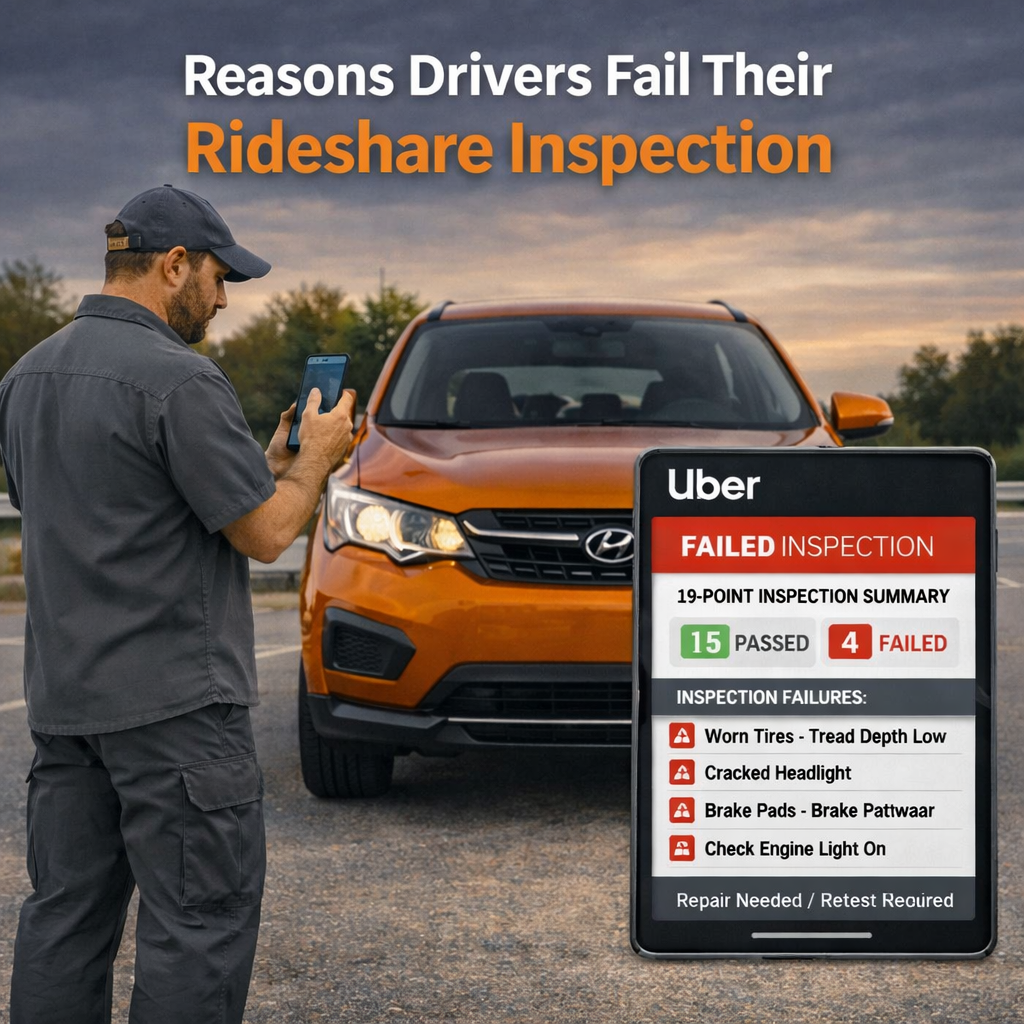
Every year, thousands of Uber and Lyft drivers walk into an inspection center expecting a quick pass and walk out with a fail. A failed rideshare inspection means wasted time, wasted money, and days of lost earnings while you fix the issue and rebook. The worst part? Nearly every fail is avoidable.
Based on data from over 50,000 inspections processed through the Chex.AI platform, five issues account for roughly 88% of all rideshare vehicle inspection failures. Every single one can be caught and fixed before your inspection if you know what to look for.
This guide breaks down what makes a car fail inspection for Uber and Lyft, explains what causes a car to fail inspection most often, and gives you a step-by-step pre-inspection checklist so you pass on the first try whether you inspect at a shop or online through Chex.AI.
What Do Uber and Lyft Actually Inspect?
Before diving into fail reasons, it helps to understand what the rideshare inspection covers. Both Uber and Lyft use a standardized 19-point vehicle inspection checklist. The Uber vehicle inspection requirements and Lyft vehicle inspection requirements are nearly identical, covering three categories:
Exterior (10 checkpoints): Headlights (high and low beam), tail lights, turn signals, brake lights, windshield condition, wipers and washer fluid, all three mirrors, tire tread and sidewall condition, body damage, and license plates with current registration.
Mechanical (5 checkpoints): Brakes (pad life, no pulling or grinding), steering responsiveness, suspension (no sagging or bouncing), exhaust system (no leaks or excessive noise), and horn.
Interior and safety (4 checkpoints): All seat belts present and latching, door locks and handles (inside and outside), dashboard warning lights (no active Check Engine, ABS, or Airbag lights), and interior condition (clean, no hazards, no strong odors).
An inspector — whether a certified mechanic, a chain shop like Jiffy Lube, or an AI-powered platform like Chex.AI — evaluates each checkpoint as pass or fail. A single fail on any item means the entire inspection fails.
Key fact: What does an Uber inspection look for? Exactly the same 19 items that Lyft checks. In most states, a passed Uber inspection form is accepted by Lyft and vice versa. So one inspection covers both platforms.
Reason #1: Active Check Engine Light (31% of Failures)
The number one reason drivers fail their rideshare inspection is an active Check Engine light on the dashboard. It accounts for nearly one in three failures and it's the most frustrating because drivers often don't realize their light is on, or they assume it's "not a big deal."
Why it causes a fail: An active Check Engine light indicates an unresolved diagnostic trouble code (DTC) in the vehicle's onboard computer. Rideshare platforms treat any active warning light — Check Engine, ABS, Airbag, or TPMS — as an automatic fail because it signals a potential safety or emissions issue.
Can a Car Pass Inspection with Check Engine Light On?
No. A car cannot pass a rideshare vehicle inspection with an active Check Engine light in any state. This applies to both Uber inspection requirements and Lyft inspection requirements. Even if the underlying issue is minor (like a loose gas cap or a failing oxygen sensor), the light itself triggers an automatic fail.
This is also true for state inspections in states like Texas, Virginia, New Jersey, Pennsylvania, and Massachusetts, a Check Engine light will fail a car inspection regardless of the cause.
How to Fix It Before Your Inspection
- Get a free OBD-II scan. Auto parts stores like AutoZone, O'Reilly, and Advance Auto Parts will scan your codes for free. The scan tells you exactly what triggered the light.
- Check the gas cap first. A loose, cracked, or missing gas cap is the single most common cause of a Check Engine light. Tighten it, drive for 50–100 miles, and the light often clears on its own.
- Address the actual code. If the scan reveals a genuine issue (oxygen sensor, catalytic converter, misfire), get it repaired. Costs range from $20 for a gas cap to $200+ for sensor replacements.
- Do not just reset the light. Some drivers reset the Check Engine light before their inspection, hoping it won't come back in time. This rarely works most inspection systems can detect a recent reset through incomplete readiness monitors, and a reset without fixing the underlying issue means the light will return, often within a single drive cycle.
- Use Chex.AI's digital inspection. Run Chex.AI inspection from your phone. The AI-powered system identifies dashboard warning lights in your submitted photos.
Pro Tip: Will a check engine light fail inspection in Texas? Yes. Will a check engine light fail inspection in Virginia? Yes. Will my car fail inspection for an airbag light? Also yes. Any active dashboard warning light is an automatic fail in every state and on every rideshare platform.
Reason #2: Worn or Bald Tires (22% of Failures)
Tires are the second most common fail reason, accounting for more than one in five rideshare inspection failures. Drivers often underestimate how quickly tread wears down, especially in high-mileage rideshare driving.
Why it causes a fail: Uber and Lyft require a minimum tread depth of 2/32 of an inch on all four tires. Inspectors also check for sidewall bulges, uneven wear patterns, exposed cords, and visible damage. Any of these is an automatic fail.
Will a Tire Pressure Light Fail Inspection?
Yes, a tire pressure monitoring system (TPMS) warning light will fail a rideshare inspection. Low tire pressure, a faulty tire pressure sensor, or a missing TPMS sensor can all trigger the light. Even if your tread is fine, the TPMS light alone is treated as a dashboard warning and results in a fail.
How to Fix It Before Your Inspection
- Do the penny test. Insert a penny head-first into the tread groove at multiple points on each tire. If you can see all of Lincoln's head, your tread is below 2/32" and you need new tires.
- Check all four tires plus the spare. Rideshare inspections don't always check the spare, but uneven wear on your main tires can indicate alignment or suspension issues that might trigger a fail elsewhere.
- Inflate to spec. Check your door jamb sticker for the correct PSI and inflate all tires to that number. This clears the TPMS light if low pressure was the only issue.
- Replace faulty TPMS sensors. If the TPMS light stays on after inflating to the correct pressure, you likely have a dead sensor. Replacement costs $50–$150 per sensor at most shops.
- Look for sidewall damage. Bulges, cuts, or bubbles on the sidewall are an automatic fail regardless of tread depth. These indicate internal structural damage and the tire must be replaced.
Cost reality: A new set of budget tires runs $250–$400 installed. That's a meaningful expense, but driving on bald tires as a rideshare driver puts passengers at risk and exposes you to liability.
Reason #3: Cracked Windshield (15% of Failures)
A cracked or chipped windshield is the third most common reason drivers fail their rideshare inspection. It's also one of the easiest to overlook many drivers live with small cracks for months without realizing they're an automatic fail.
Why it causes a fail: Any crack in the driver's primary line of sight (the area swept by the wipers) is an automatic fail. Chips larger than a quarter, cracks longer than 6 inches, or multiple chips in a cluster also fail. The windshield is considered safety-critical because it contributes to the structural integrity of the cabin in a rollover.
Will a Small Crack in Windshield Fail Inspection?
It depends on location and size. A small chip outside the driver's line of sight may pass, but any crack even a small one within the wiper sweep area will fail a rideshare inspection. When in doubt, assume it will fail. Inspectors err on the side of caution.
How to Fix It Before Your Inspection
- Check your insurance first. Many comprehensive auto insurance policies cover windshield replacement at zero out-of-pocket cost. In some states (Florida, Kentucky, South Carolina), insurers are legally required to cover windshield replacement without a deductible.
- Get chips repaired before they spread. A chip repair costs $50–$100 and takes 30 minutes. Once a chip turns into a crack, repair becomes impossible and you'll need a full replacement ($200–$500+).
- Don't ignore new chips. Temperature changes, bumps, and vibration cause chips to spread quickly especially in rideshare driving where you're on the road 6–10 hours a day.
- Pre-screen with Chex.AI. Chex.AI's AI damage detection engine analyzes windshield condition from your submitted photos and can flag cracks or chips that would trigger a fail before you pay for an in-person inspection.
Reason #4: Burned-Out or Malfunctioning Lights (12% of Failures)
Lighting issues account for 12% of rideshare inspection failures. This includes headlights, tail lights, brake lights, turn signals, reverse lights, and license plate lights. A single burned-out bulb anywhere on the vehicle is enough to fail the entire inspection.
Why it causes a fail: Functioning lights are a fundamental safety requirement. Rideshare drivers operate at all hours, often in low-visibility conditions. A burned-out headlight or brake light is a direct hazard to passengers and other drivers.
Common Light Failures That Catch Drivers Off Guard
- One headlight dimmer than the other — This can indicate a failing bulb, corroded connector, or foggy lens. Some inspectors will fail a headlight that's significantly dimmer than its pair even if it's technically working.
- Fast-blinking turn signal — A turn signal that blinks faster than normal indicates a burned-out bulb on that circuit. The fast blink is the car telling you a bulb is dead.
- License plate light — Most drivers never check this. It's a small bulb above or below the rear license plate. If it's out, you fail.
- Third brake light (CHMSL) — The center-mounted high brake light on the rear window or trunk lid. Easy to miss, easy to fail.
How to Fix It Before Your Inspection
- Do a full light walk-around. Park facing a wall at night. Turn on your headlights (low and high beam), then walk around the car checking every light. Have someone press the brake pedal and activate each turn signal while you watch.
- Replace bulbs yourself. Most car bulbs cost $5–$15 and can be swapped in minutes with no tools. YouTube has step-by-step videos for virtually every make and model.
- Clean foggy headlight lenses. A headlight restoration kit costs $10–$20 at any auto parts store. Cloudy lenses reduce light output by up to 80% and can trigger a fail even if the bulb is fine.
- Check reverse lights and license plate lights specifically. These are the two most-missed lights in pre-inspection checks.
Reason #5: Seat Belt Issues (8% of Failures)
Seat belt failures account for 8% of rideshare inspection fails. Unlike the other four reasons, seat belt problems are often invisible until someone actually tries to use the belt — which means many drivers have no idea there's an issue until the inspector pulls the rear belts.
Why it causes a fail: Every seating position in a rideshare vehicle must have a functioning seat belt. If a single belt including rear center doesn't latch, doesn't retract, shows visible fraying, or has a broken buckle, the entire inspection fails.
Most Common Seat Belt Issues
- Rear seat belts that don't retract. Belts that have been tucked into seat cushions for months can develop retraction problems. Coins, food, and debris lodged in the retractor mechanism prevent the belt from pulling back.
- Buckles that don't latch securely. Over time, buckle mechanisms wear out or get clogged with debris. If the belt clicks in but releases under a firm tug, it fails.
- Visible fraying or cuts. Any visible damage to the belt webbing is an automatic fail, even if the belt still latches.
- Missing rear center belt. Some older vehicles have a lap-only belt for the rear center position. Inspect it specifically it's the most commonly overlooked belt in the vehicle.
How to Fix It Before Your Inspection
- Buckle and tug every belt. Sit in every seat (including rear center), buckle the belt, and pull firmly. The belt should lock under quick tension and release cleanly from the buckle.
- Clean sticky retractors. If a belt doesn't retract smoothly, pull it out fully and let it retract slowly. Repeat 5–10 times. If it's still sluggish, spray a small amount of silicone lubricant into the retractor opening.
- Clear debris from buckles. Use compressed air to blow out crumbs, coins, and dirt from the buckle receptor. This often fixes latching issues instantly.
- Replace damaged belts. If a belt is frayed, cut, or the buckle mechanism is broken, it must be replaced. Aftermarket seat belt replacements run $30–$80 per belt. Dealer parts cost more but come with exact-fit guarantee.
What Happens If You Fail Your Rideshare Inspection?
If you fail a car inspection for Uber or Lyft, here's what to expect:
Immediate consequences:
- You cannot go online or accept ride requests until you upload a passed inspection form
- You've spent the inspection fee ($15–$75) with nothing to show for it
- You need to fix the failed item, then pay for a re-inspection
Re-inspection process:
- Most shops will re-inspect for free or at a reduced rate within 30 days if you fix the failed item and return to the same location
- Some shops charge the full fee again regardless
- Chex.AI allows you to re-submit without driving back to a shop to fix the issue, and re-inspect from your phone
Timeline impact:
- A fail typically adds 3–7 days to your activation timeline (time to get repairs done + rebook + wait for re-inspection)
- For new drivers, this delay can mean missing your first week of potential earnings — $500–$1,000+ depending on your market
What happens if you fail a car inspection in specific states:
- Pennsylvania: You have 30 days to repair and re-inspect at the same station for free
- Texas: You must repair the failed items and return for re-inspection; the station must re-inspect failed items at no additional charge
- New Jersey: You receive a rejection sticker and must repair and re-inspect within 30 days
- Missouri: The inspection station provides a list of deficiencies; you repair and return
- Virginia: Failed vehicles receive a rejection sticker valid for 15 days during which repairs must be completed
State-Specific: What Will Fail a Car Inspection?
While the 19-point rideshare checklist is nationally standardized, some states have additional requirements that can catch drivers off guard. Here's what to watch for in the most common states.
What Will Fail a Car Inspection in NJ?
New Jersey has one of the strictest inspection programs in the country. In addition to the standard 19-point rideshare checklist, NJ inspections include an emissions test. Vehicles that fail emissions will also fail the rideshare inspection in New Jersey, even if every other item passes.
What Will Fail a Car Inspection in PA?
Pennsylvania requires an annual state safety inspection on top of the rideshare form. Common additional fail reasons in PA include: rusted brake lines, excessive frame rust, emissions failures, and windshield tinting that's too dark. PA inspectors are known to be thorough.
What Will Fail a Car Inspection in Missouri?
Missouri vehicle inspections focus heavily on brakes and steering. A common surprise fail is excessive steering wheel play if the steering has more than 2 inches of free play before the wheels respond, you'll fail in Missouri.
What Will Fail a Car Inspection in VA?
Virginia has a detailed inspection checklist that goes beyond the rideshare requirements. Additional Virginia-specific fail reasons include: horn that's not loud enough, windshield wipers that streak excessively, and mirrors that are too small or improperly mounted.
What Will Fail a Car Inspection in MA?
Massachusetts requires a state inspection sticker in addition to the rideshare inspection form. MA inspections include an OBD-II emissions check, and any vehicle with a Check Engine light even if the underlying code is minor will fail. Massachusetts also checks exhaust noise levels more strictly than most states.
What Will Fail a Car Inspection in Texas?
Texas requires an annual state safety inspection that covers everything on the rideshare checklist plus emissions testing in most counties. Will a check engine light fail inspection in Texas? Absolutely it's one of the top fail reasons in the state.
What Will Fail a Car Inspection in NY?
New York has a comprehensive state inspection that includes both safety and emissions components. NYC rideshare drivers face additional TLC (Taxi & Limousine Commission) requirements including a more rigorous vehicle age limit and a separate TLC-specific inspection.
The Pre-Inspection Checklist: How to Pass on the First Try
Use this checklist the night before your rideshare inspection to catch every common fail reason before the inspector does.
Dashboard Check (2 minutes)
- Start the car and check for any active warning lights (Check Engine, ABS, Airbag, TPMS, Oil)
- If any light is on, get it diagnosed before proceeding with the inspection
- Confirm the horn works by pressing it
Exterior Light Check (5 minutes — have a helper press the brakes)
- Headlights — low beam, both sides
- Headlights — high beam, both sides
- Tail lights — both sides
- Brake lights — both sides (have someone press the pedal)
- Turn signals — front left, front right, rear left, rear right
- Reverse lights — both sides
- License plate light
- Third brake light (center high-mount)
Tire Check (5 minutes)
- Penny test on all four tires at multiple tread points
- Visual check for sidewall bulges, cuts, or bubbles
- Confirm TPMS light is off
- Check tire pressure against door jamb spec
Windshield and Glass Check (2 minutes)
- Inspect windshield for cracks or chips in the driver's line of sight
- Check that both wipers clear the windshield cleanly
- Confirm washer fluid sprays from both nozzles
- Verify all mirrors are intact, not cracked, and properly adjusted
Seat Belt Check (3 minutes)
- Test driver seat belt — buckle, tug, release
- Test front passenger seat belt — buckle, tug, release
- Test rear left seat belt — buckle, tug, release
- Test rear center seat belt — buckle, tug, release
- Test rear right seat belt — buckle, tug, release
Interior and Body Check (3 minutes)
- All doors open and close from inside and outside
- All door locks engage and disengage
- No major body damage or sharp edges
- Interior is clean — no trash, excessive odor, or torn seats exposing springs
- Registration is current and plates are properly mounted
Total time: 20 minutes. That's all it takes to catch 88% of potential fail reasons before they cost you time and money.
Inspect Online with Chex.AI
You've just reviewed every common fail reason and what to fix. Now the question is where should you get inspected?
Most drivers default to an independent mechanic. But Chex.AI is faster, more thorough option that eliminates the shop visit entirely.
Why Drivers Are Switching to Chex.AI
Chex.AI is an AI-powered rideshare inspection platform that lets you complete your Uber or Lyft vehicle inspection entirely from your phone no appointment, no shop, no waiting.
Here's how it works:
- Open Chex.AI on your phone and log in
- Follow the guided walkthrough the app tells you exactly which angles to photograph and what to check at each step
- AI scans your vehicle Chex.AI damage detection engine analyzes 163 vehicle parts and identifies 21 types of damage at 95–99% accuracy
- Receive your digital report a complete, signed inspection report is generated in minutes
- Upload to Uber or Lyft the report is accepted by both platforms
Chex.AI vs. In-Person Inspection
| Factor | In-Person Shop | Chex.AI |
|---|---|---|
| Time | 1–2 hours (drive + wait + inspection) | Under 20 minutes |
| Appointment | Usually required | None needed |
| Location | Must drive to the shop | Anywhere with your phone |
| What's checked | 19-point checklist (human inspector) | 163 vehicle parts (AI-powered) |
| Damage detection accuracy | Varies by inspector | 95–99% across 21 damage types |
| Fraud protection | None | AI flags manipulated, duplicate, or stale photos |
| Report format | Paper form (you scan and upload) | Digital report (direct upload) |
| Re-inspection if fail | Drive back, often pay again | Fix the issue, re-submit from phone |
| Record storage | Your responsibility | Stored securely in your Chex.AI dashboard |
The Chex.AI Advantage for Avoiding Fails
The biggest value Chex.AI provides isn't just convenience it's catching problems before they become fails. The AI system identifies dashboard warning lights, windshield damage, tire wear, and body damage from your photos and alerts you to potential fail items before your inspection is submitted. That means you can fix issues and re-photograph without losing an inspection fee or driving back to a shop.
Think of it as a pre-inspection built into the inspection itself.
Ready to inspect? → Complete your Uber inspection with Chex.AI → Complete your Lyft inspection with Chex.AI
Frequently Asked Questions
What makes a car fail inspection for Uber and Lyft?
The five most common fail reasons for rideshare inspections are: an active Check Engine light (31% of fails), worn or bald tires (22%), a cracked windshield (15%), burned-out lights (12%), and seat belt issues (8%). Any single checkpoint failure on the 19-point inspection results in a full inspection fail.
Can you pass inspection with check engine light on?
No. You cannot pass a rideshare vehicle inspection with an active Check Engine light. This is an automatic fail on both Uber and Lyft inspections in every state. Get the light diagnosed and resolved before booking your inspection.
Will my car pass inspection with check engine light on?
No. An active Check Engine light will fail a rideshare inspection regardless of the underlying cause. Even a minor issue like a loose gas cap that triggers the light will result in a fail until the light is off and the diagnostic codes are cleared.
What will fail a car inspection?
Common items that fail a car inspection include: active dashboard warning lights (Check Engine, ABS, Airbag, TPMS), tires with tread below 2/32", windshield cracks in the driver's line of sight, any burned-out exterior light, non-functioning seat belts, excessive body damage, non-working horn, and leaking exhaust systems.
What happens if you fail a car inspection?
If you fail a rideshare inspection, you cannot go online or accept rides until you fix the failed items and pass a re-inspection. Most shops offer free re-inspection within 30 days. With Chex.AI, you can fix the issue and re-submit your inspection from your phone without returning to a shop.
Will a tire pressure light fail inspection?
Yes. An active TPMS (tire pressure monitoring system) warning light is treated as a dashboard warning and will fail your rideshare inspection. Inflate your tires to the correct pressure listed on the door jamb sticker. If the light persists, you may have a faulty sensor that needs replacement.
Will a small crack in windshield fail inspection?
It depends on location. Any crack within the driver's primary line of sight (the area swept by the wipers) will fail the inspection, regardless of size. Small chips outside this area may pass, but larger chips or any crack longer than 6 inches will fail. When in doubt, get it repaired before your inspection.
Does Uber require vehicle inspection?
Yes. Every Uber driver must complete and upload a passed 19-point vehicle inspection form before they can go online. The inspection must be renewed annually in most states and can be completed at a certified mechanic, a chain shop, or online through Chex.AI.
How much is an Uber inspection?
An Uber vehicle inspection typically costs between $15 and $75 at shops like Jiffy Lube, Pep Boys, and Firestone. Some Uber Greenlight Hub locations offer free inspections but have limited availability. Online inspection through Chex.AI is also available check chex.ai for current pricing.
What will fail a car inspection in NJ?
In New Jersey, common fail reasons include everything on the standard 19-point checklist plus emissions test failures. NJ inspections are stricter than many states, and vehicles must pass both safety and emissions components.
Do you need a vehicle inspection for Uber Eats?
In most markets, yes. Uber Eats drivers using a car must complete the same vehicle inspection as UberX drivers. Bike and scooter delivery drivers are exempt. The same 19-point checklist applies.
What do you need for a car inspection?
For a rideshare vehicle inspection, you need: your vehicle, current registration, a valid driver's license, and the inspection form for your platform (available in the Uber or Lyft driver app, or completed digitally through Chex.AI). You'll also need the vehicle to be in the condition described in the 19-point checklist above.
Pass Your Inspection the First Time
Now you know exactly what makes a car fail inspection for rideshare and more importantly, how to prevent each failure. The 20-minute pre-inspection checklist above catches 88% of fail reasons. Run through it the night before, fix any issues you find, and walk into your inspection with confidence.
Or skip the walk-in entirely. Chex.AI lets you inspect from your driveway in under 20 minutes, catches potential fail items before they cost you, and generates a digital report accepted by both Uber and Lyft. No appointment. No shop. No surprises.